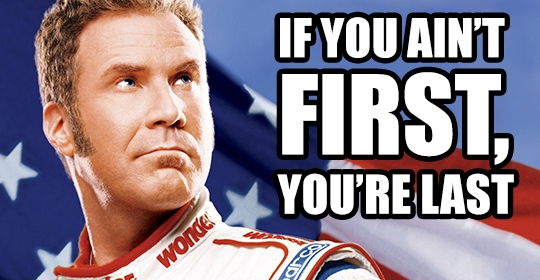
If you ain’t first, you’re last
Ricky Bobby, Talladega Nights: The Ballad of Ricky Bobby
Talladega Nights is an old Will Ferrell comedy (also starring Sacha Baron Cohen of Borat fame) about a NASCAR racer who loses his mojo after a crash and learns to regain his passion again after connecting more deeply with friends and family.
Ricky Bobby’s estranged father imparts the above words of racing wisdom to an impressionable young Ricky, which sound both ridiculously obvious and wrong. But in the business context, there is a kernel of truth for startups and large companies.
Peter Thiel wrote about the desirability of monopolies in his book Zero to One — the “kind of company that is so good at what it does that no other firm can offer a close substitute.” There are very few businesses in the world that qualify, but if a company were an F1 car, these monopolies would have the best cars, engines, and teams that enable them to win the race every time.
Why is it so important to be “first” (i.e., best) and not “last” (i.e., average)?
It turns out that many markets follow a power law distribution of economic profit.


In other words, many markets are “winner-take-all” or “winner-take-most”. When traditional markets mature and consolidate, there are usually 3-5 players that control the market. With the advent of the internet and digital distribution, technology companies have taken on a more extreme dynamic where the Ricky Bobby dynamic feels pretty accurate.
In normal markets, you can have Pepsi and Coke. In technology markets, in the long run, you tend to only have one…. The big companies, though, in technology tend to have 90 percent market share. So we think that generally, these are winner-take-all markets. Generally, number one is going to get like 90 percent of the profits. Number two is going to get like 10 percent of the profits, and numbers three through 10 are going to get nothing.
Marc Andreessen
For these winner-take-all stakes to matter, you need to pick the right markets (“where to play”). The prize for being the best restaurant in Palo Alto is many orders of magnitude smaller than controlling the global digital advertising market. But assuming your total addressable market is sizable and attractive, it makes sense to think about strategy as a startup or incumbent through the lens of competitive differentiation (“what are we obviously better at than everyone else?”).
In my consulting career, I always felt this question was superficially answered or not deeply understood by my clients about themselves (often larger incumbents). Sometimes the competitive differentiation cited were things that didn’t really matter. Providing great customer service or having a well-known brand is great, but not something that will typically endure to attain or preserve monopoly-like advantage. For many older, larger companies, this edge was once there but can be lost over time through complacency, which makes them vulnerable.
For the startup barbarians at the gate, the incumbent moat can be quite deep, which is why swinging for the fences Ricky Bobby-style is both audacious and absolutely required to succeed.
Healthcare is an interesting market upon which to apply the Ricky Bobby theory. The sheer size of the market has attracted the likes of Amazon, Google, Microsoft, and Apple (TikTok?), presumably because of the need to find new large end markets in which to grow.
This pursuit by both big tech and tech-enabled startups could end up being a Don Quixote quest, in large part because healthcare is a multitude of many different markets. The fragmentation and local nature of the market make healthcare the anti-Internet. And while telehealth had its moment when the world locked down during the height of the COVID pandemic, virtual care by itself is not good enough as a substitute to displace traditional brick-and-mortar providers and there isn’t enough differentiation among the multitude of virtual care providers to allow any of them to clearly be the best.
How are the incumbents in healthcare holding on? The easy answer is “scale”, but that by itself isn’t why they win. Amazon has scale, but not in the right way, at least not yet. In most healthcare markets, the incumbents win because of local market dominance; they are often the only real game in town for an employer or a patient (i.e., a monopoly). And in care delivery, the scarce resource is the physician, the supply of which is constrained and restricted. Competitive differentiation in healthcare is not just about how your offering is clearly better for patients, it is also about why it is obvious a physician should work for your company.
Unlike Nascar racing where the circular track never changes, one of the best ways to beat an incumbent is to redefine the game — to target an underserved customer segment, to address an unmet need that no one cares enough about, or to introduce a value proposition that the incumbents never saw coming. This is certainly how Apple’s iPhone found its way over the years with the touch screen, the App Store, and a new business model with the carriers. The iPhone wasn’t just incrementally better than the other phones on the market, it was obviously better in a way that allowed Apple to control most of the profits of the smartphone industry. It isn’t surprising that just recently iOS phones have overtaken Android phones in market share in the US. Being “not iPhone” in this market (even for Google/Samsung) may just not matter in the long run; it could be the same as being last.
Leave a Reply