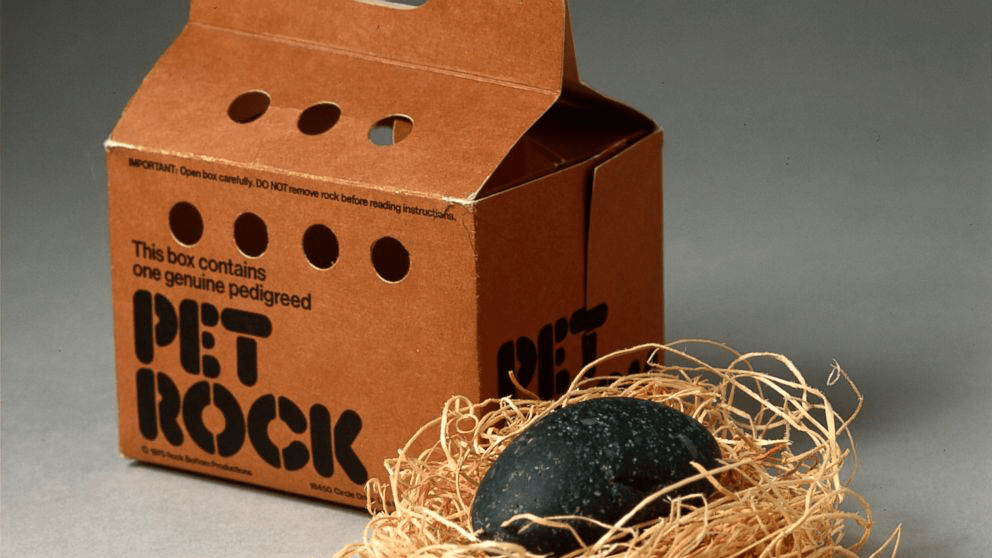
Many of you are probably not old enough to remember, but there was a brief time when pet rocks were a craze and sold out in stores across the country. There have been many fads throughout history, from tulip mania to Garbage Pail Kids.
When you are in the middle of a fad, it can be hard to tell that this thing that everyone is crazy about is here to stay or will fade away. Remember when everyone was walking around the neighborhood collecting virtual Pokémon? The collective psychology on why something is so exciting can be hard to resist in the moment.
These fads grow virally through word of mouth and given the adoption of mobile devices and social media, our world has arguably become more fad-like or memeable than ever.
Speaking of viruses, we have seen the boom and bust of fad-like behaviors and services throughout the COVID-19 pandemic, including Peloton bikes, telemedicine, and Zooming into work from home.

What’s not always obvious in the moment, however, is when certain fads take hold in the culture and become longer-term trends.
In his 2016 Letter to Shareholders, Jeff Bezos wrote about Day 1 defense and fending off Day 2. One of the tactics is “Embrace External Trends”.
The outside world can push you into Day 2 if you won’t or can’t embrace powerful trends quickly. If you fight them, you’re probably fighting the future. Embrace them and you have a tailwind.
These big trends are not that hard to spot (they get talked and written about a lot), but they can be strangely hard for large organizations to embrace. We’re in the middle of an obvious one right now: machine learning and artificial intelligence.
Jeff Bezos
COVID forced us to adopt new behaviors because of lock-downs and quarantines, so these COVID “fads” were artificially engineered rather than organically viral. While COVID continues to circulate around the world, many of these “fads” have dissipated, not surprisingly, as behaviors revert back to pre-COVID norms.
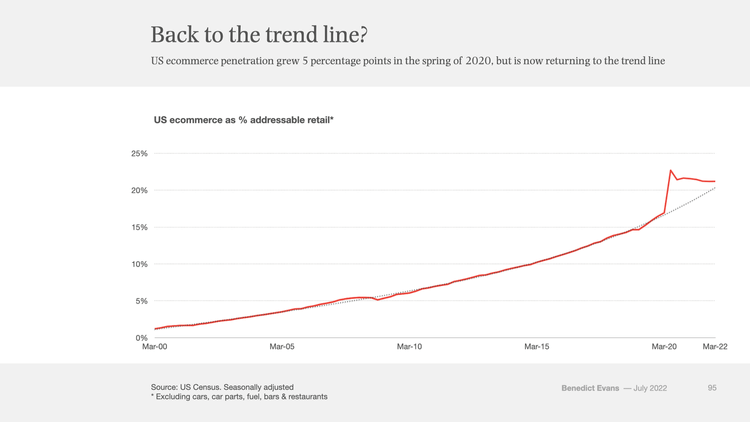
Many companies beyond Peloton prematurely mistook COVID to be a trend rather than a “fad”, including Amazon who overbuilt capacity in its supply chain. It looks like e-commerce is reverting back to the long-term trend line, though the long-term trajectory does in fact appear to be a durable trend.
Even if COVID “goes away” (for the record, I don’t think this is happening for a while), some of our COVID-induced behaviors are likely to stick around and turn into trends. Take Pokemon Go as an example: while the AR game peaked in popularity back in 2016, there are still tens of millions of users who play the game on a regular basis.
Remote/hybrid work in some form will persist, even as large companies attempt to reel employees back full time to the office this fall. Telemedicine is becoming more mainstream as a modality for all doctors, not just virtual-only urgent care startups. I would bet some types of business travel have fundamentally changed. I used to fly cross-country for 1-hour in-person meetings as a consultant and that is probably gone forever (not to mention the carbon impact, which no one worried about back then).
What makes a fad turn into a trend? I like this quote from Seth Godin:
A fad is popular because it’s popular. A fad gives us momentary joy, and part of the joy comes in knowing that it’s momentary. We enjoy a fad because our peers are into it as well.
A trend, on the other hand, satisfies a different human need. A trend gains power over time, because it’s not merely part of a moment, it’s a tool, a connector that will become more valuable as other people commit to engaging in it.
Confusion sets in because at the beginning, most trends gain energy with people who are happy to have fun with fads, and it’s only when the fad fans fade away (yes, I just wrote ‘fad fans fade’) that we get to see the underlying power of the trend that’s going on.
Seth Godin
In retrospect, COVID was a flashlight that put a spotlight on human needs long ignored or unaddressed. I had a 60-90 minute commute that I did every day from San Francisco to Cupertino that I accepted as a given before COVID. I would bet that I’m not alone when I say I can’t imagine going back to that daily routine. I am getting much better sleep, more time to exercise, and quality time spent with family — very basic quality of life needs that I’m not willing to give back easily. It’s too late for many people — the cat is out of the bag — and this is why some of these behaviors are likely to stick around as longer-term trends.
There are also new trends that will likely emerge in the COVID aftermath. The uptick in leisure travel and tourism around the world might seem to be pent-up demand from trips long deferred, but everyone being cooped up for 2 years might lead to a longer-term desire to see the world and “not miss out”. In the same way that the Great Depression left a lasting psychological mark on people who lived during that time, I would bet that everyone who lived through a once-in-a-century (hopefully) pandemic will have fundamentally new needs and desires that persist.

 Be Curious, Not Judgmental